
Description
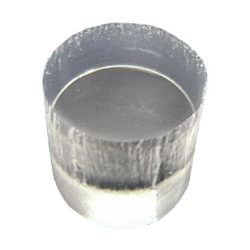
NaI(Tl) Scintillation Crystal is the most widely used scintillation material. It is based on a NaI substrate doped with a certain concentration of thallium. It is the standard everything else is measured against.
NaI(Tl) Scintillation Crystal specifications
Density: 3.67 g/cm³. Radiation length: 2.59 cm. Hardness: 2 Mohs. Decay constant: 250 ns. Index of refraction: 1.85. Afterglow: 0.3-5% at 6 ms. Peak emission: 415 nm. Light yield: 38,000 photons/MeV. The 250 ns decay suits moderate count rates. Low afterglow keeps successive pulses clean. 38,000 photons/MeV is the benchmark. Density 3.67 keeps detectors compact for portable use.
NaI(Tl) Scintillation Crystal performance
The 415 nm emission sits in the maximum-efficiency region of bialkali-photocathode PMTs. No obvious self-absorption in the glow wavelength keeps light collection high. Good resolution for both x-rays and gamma rays follows. Decades of instruments standardize on it. The wide availability keeps costs down. Well-logging tools run it downhole for years. Handle it with care against moisture and mechanical shock.
Typical applications
Nuclear medicine. High energy physics. Oil well logging. Geologic survey. Environmental monitoring. Teaching labs use it for spectroscopy basics. Environmental monitors rely on its stability. Physics labs keep it as the reference detector. Match the crystal to your energy range. For higher resolution, see our SrI2(Eu) Scintillation Crystal.
Request a quote for NaI(Tl) Scintillation Crystal with your crystal size and housing requirements. Specify the detector geometry for matched packaging. Specify encapsulation for hygroscopic protection.